Why Are Initiatives Like This Important?
The modern world faces numerous environmental challenges. Growing consumption leads to increased use of natural resources, energy and water. Every manufactured item leaves an environmental footprint related to the extraction of raw materials, transportation, production processes and disposal. When we throw away items that are still usable, we waste not only the objects themselves but also the resources used to produce them.
One of the simplest ways to reduce our environmental impact is to extend the life cycle of products and act in accordance with the principles of the circular economy. Passing on an item that is no longer needed allows us to reduce waste and decrease demand for newly manufactured products. It is a small action which, across an entire community, can bring tangible benefits for the planet.
A Small Step Towards Sustainable Development
The Exchange Points reflect the principles of sustainable development, which promote the responsible use of resources in a way that meets the needs of the present without compromising the ability of future generations to meet their own needs. In practice, this means responsible resource management, waste reduction, promoting conscious consumption and supporting a circular economy.
Instead of buying new items, we should consider whether what we need is already available within circulation. Similarly, before throwing something away, it is worth asking whether it could still be useful to someone else. This approach helps save natural resources, reduce waste and foster a culture of responsibility for the common good.
How Do the Exchange Points Work?
The idea is simple. If you have an item you no longer use but which remains in good condition, you can leave it at one of the Exchange Points. In return, you may find something that could be useful to you.
As part of the Bio4Pak project, an application has been developed to support the monitoring of the environmental impact of reusing items. The tool enables users to register the transfer of objects between individuals and estimate the associated carbon footprint savings.
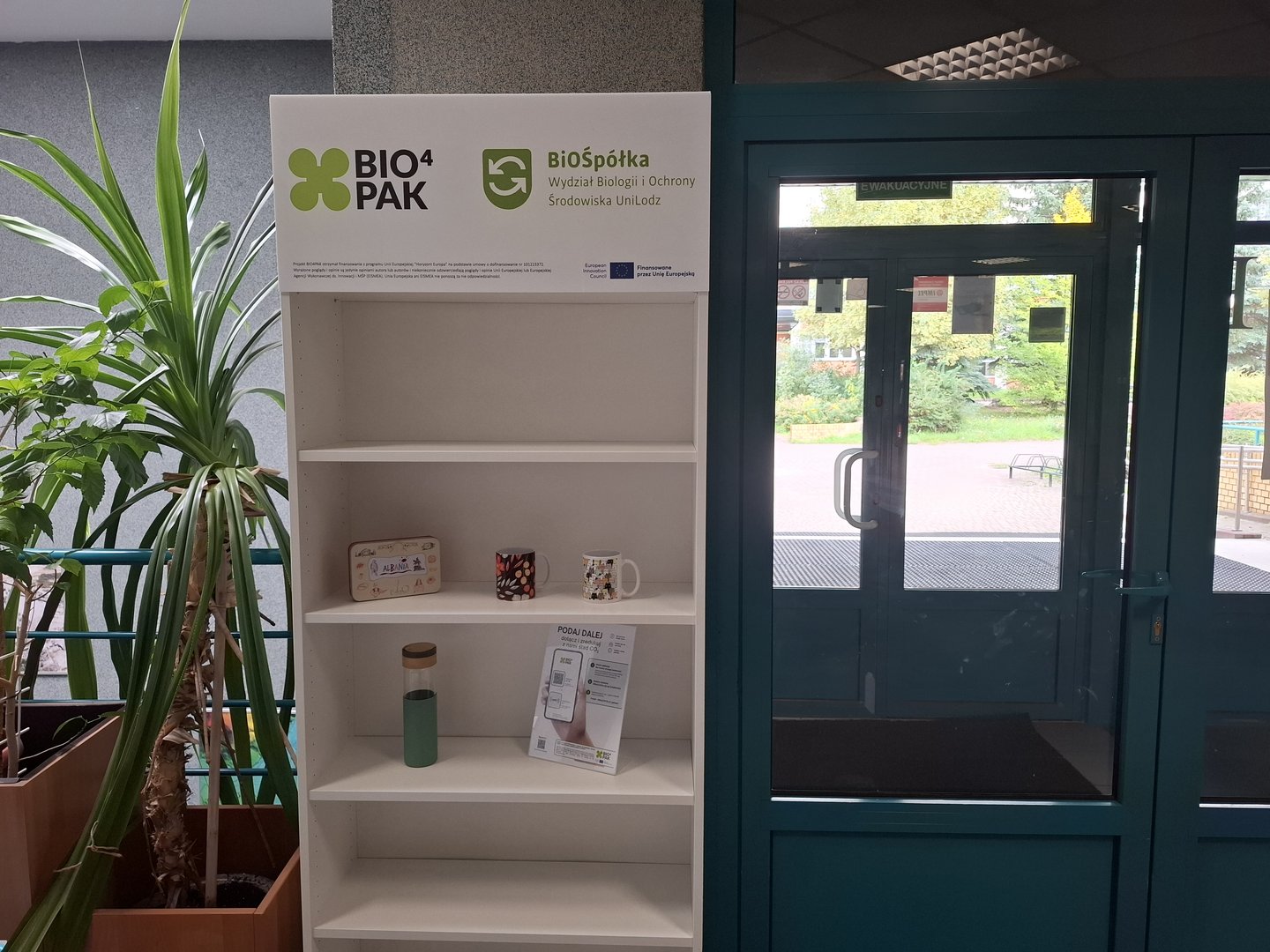
Using the application is quick and straightforward. After scanning a QR code or using an NFC reader, the user selects the appropriate option, “I'M GIVING” or “I'M TAKING”, then takes a photograph of the item and uploads it via the application.
Based on the recorded data, the application automatically calculates the estimated amount of CO₂ emissions associated with producing a given item that can be avoided through its reuse. This helps illustrate the environmental impact of everyday decisions concerning sharing and reusing objects.
The Collective Impact of Our Actions
Data on registered exchanges will be aggregated once a week, making it possible to determine the total estimated carbon footprint savings achieved through the initiative. The results will be displayed on faculty information kiosks, allowing members of the academic community to monitor the impact of their actions on an ongoing basis.
A Few Rules for Using the Exchange Points
Items that can be brought to the Exchange Points include:
- books,
- mugs,
- organisers,
- decorations,
- small everyday items,
- other objects that are clean, functional and complete.
To ensure the Exchange Points operate effectively, please follow a few simple rules:
- bring only items that are clean, functional and complete, and that may still be useful or enjoyable for someone else;
- do not leave food, cosmetics, medicines, chemicals or other potentially hazardous materials;
- take only items that you genuinely need;
- help ensure that the items find a new home for the long term.
To maintain order and ensure a regular turnover of items, a review of donated objects will be carried out once a month.
Detailed rules governing the Exchange Points can be found in the Rules of the Initiative (in Polish).
Together We Can Do More
Protecting the environment does not always require major investments or radical changes. It often begins with simple, everyday choices. Passing on an unwanted book, giving away a mug or finding a new owner for an item gathering dust on a shelf are actions that can have a real impact on reducing waste, anthropogenic pressure and environmental degradation.
We encourage the entire academic community to make use of the Exchange Points. Together, we can create a more responsible and environmentally friendly place to study and work.
Instead of throwing it away, pass it on. A small gesture → a real change!
Text: Kamila Knol-Michałowska (Promotion Centre, Faculty of Biology and Environmental Protection, University of Lodz)
Edit and graphic design: Mateusz Kowalski (Promotion Centre, Faculty of Biology and Environmental Protection, University of Lodz)